Predictive Highway & Enforcement Intelligence
From reactive maintenance & static speed limits to a predictive, self-learning highway brain
About Trinesis
Gen AI-driven process automation & software engineering for manufacturing, industrial & utility leaders
Global Footprint
- HQ & Innovation Hub
Pune, India
- Sales Offices
Germany & Austin, TX, USA
- Around-the-Clock Support
24×7 global availability - your network never stops
Recognition & Partnerships
Process-automation specialists in ML, data analytics, agentic & generative AI - streamlining operations across industrial & utility customers.
Our Expertise
The same engineering depth that builds FluxAI - from Gen AI to ERP
GenAI & Agentic AI
Autonomous agents and LLM applications that decide and act - not just answer.
Machine Learning & Analytics
Forecasting, predictive & anomaly-detection models that turn telemetry into foresight.
Computer Vision
Image & video models for ANPR, road-defect and roadside-asset inspection at scale.
Our Solution
Meet FluxAI - an autonomous intelligence layer for traffic, enforcement & field operations
FluxAI connects your NMS, ATMS controllers, ANPR & radar, VMS, field-service, ERP and traffic/weather feeds to answer three operations-critical questions:
What is likely to occur?
Which asset failure, network fault or traffic/safety risk is likely to occur across your corridors.
When will it happen?
When it will hit uptime, enforcement coverage, SLAs and road safety - days to weeks ahead.
What action to take?
Which engineer & spare to dispatch, which speed to set, which junction to re-engineer - proactively.
Sits on top of your existing ATMS & software stack - no rip-and-replace, on-premises, your data stays yours.
How FluxAI Works
Sits on top of your stack - then discovers, decides, builds & deploys, autonomously
Asset telemetry
Controllers
Enforcement
Signs & speed
Tickets & spares
Live feeds
SAP / Tally
Connect & Unify
Taps every distributed source and fuses them into one operational truth.
Discover Patterns
Mines history for failure signatures, congestion & weather patterns.
Decision Intelligence
Autonomously designs the ML pipeline - no data scientist required.
AutoML: Build & Train
Generates, tests & trains candidates - picks the best model.
Deploy & Serve
Pushes trained models live to power every use case below.
Where We Left Off
Quick recap of our first conversation, Rahul
What You Told Us
-
Your ATMS software is already in place
A strong in-house software team, own ANPR engines, and Acusensus-derived "Ador Harmony" enforcement on the Mumbai-Pune Expressway since 2018-19. The platform isn't the gap.
-
You want dynamic, condition-aware speeds
Predict congestion windows & vehicle mix, set speeds by time-of-day, and warn "rain ahead in the ghats - slow down" - to take to NHAI.
-
Predictive analytics on your NMS-connected assets
You see what's up/down today - but want to predict chronic-fault junctions, network vs power vs hardware causes, before they fail.
-
"Narrow it down to one or two things"
Show a POC on asset management & predictive analytics - then bring your software team in to take it forward.
What We Aligned On
-
Two focused POCs - exactly what you named
(1) Predictive asset health on the hardware/NMS side, and (2) dynamic speed & road-condition prediction.
-
We add the ML layer - not replace your team
FluxAI complements your existing ATMS suite. Your team keeps owning the platform; we bring predictive intelligence.
-
On-premises, on your data, under your control
Read-only taps on NMS, ATMS & enforcement data - nothing leaves your environment.
-
Prove on one corridor → scale across the network
Start on the Mumbai-Pune Expressway, then roll out to other corridors & NHAI projects - with your team alongside.
Our Vision for Ador
One adaptive operating brain across assets, enforcement & traffic flow
Predictive Asset Health & Maintenance
Learns the failure signatures behind every NMS alarm to predict which cameras, radars, VMS & controllers will fail - and flags chronic network/power/hardware junctions before they take coverage down. POC #1.
Dynamic Speed & Road-Condition Intelligence
Forecasts congestion windows and vehicle mix, recommends time-of-day variable speed limits, and pushes weather advisories ("rain ahead, slow down") to your VMS - ready for NHAI. POC #2.
AI Field-Service & Spares Optimization
Turns predictions into action: which engineer and which spare to dispatch to which junction, before a citizen-facing outage - cutting truck-rolls and mean-time-to-repair.
Enforcement & Vehicle-Pattern Analytics
Repeat-offender & vulnerable-vehicle detection from ANPR history, plus dashcam-based road-defect anomaly scoring - extending the value of data you already capture.
Use Case 1: Predictive Asset Health & Maintenance
Your hardware / NMS ask - predict failures & chronic-fault junctions before they take coverage down
| Asset · Location | Health | Predicted Failure | Likely Cause | Status | FluxAI Action |
|---|
Use Case 2: Dynamic Speed & Road-Condition Intelligence
Your road-conditions ask - congestion & weather-aware variable speed limits for NHAI
Rain + reduced visibility detected Km 60-72. FluxAI drops advisory to 60 km/h and auto-pushes "RAIN AHEAD · SLOW DOWN" to upstream VMS gantries.
Use Case 3: AI Operations Assistant
Ask in plain English. Get instant, sourced answers across assets, traffic & enforcement.
23 of 64 assets are at elevated failure risk (6 critical). Top 3 by urgency:
- Speed Radar · Km 63 Lonavala - down now, hardware fault
- ANPR Camera · Km 42 Khalapur - fail ~12 Jul, power fluctuation
- ESP Power Supply · Km 50 - fail ~18 Jul, capacitor aging
Recommended: dispatch engineer EN-04 to Km 63 today with a spare radar unit; pre-stage a UPS for Km 42 on the same run.
Recommend 60 km/h on Km 60-72 (ghat section). Reasoning:
- 18:00 is a PM-peak window - predicted density is already high
- Rain + low visibility detected on the descent - stopping distance up ~40%
- Multi-axle share rising - downhill braking risk elevated
Drafted VMS message: "RAIN AHEAD · SLOW TO 60" - ready to push to gantries at Km 55 & Km 58.
Executive Dashboard
360° visibility for leadership - live, across corridors
Drive it live - Asset Health, Dynamic Speed & the AI Assistant. Ships on-prem, wired to your NMS & ATMS feeds.
The POC Behind the Demo
Not slideware - a real, reproducible ML pipeline run on data that mirrors your NMS & ATMS feeds
1 · Synthetic Data
NMS telemetry + corridor traffic, schema-matched to Ador exports
2 · Feature Eng.
Rolling means & slopes, lags, cyclical & weather features
3 · AutoML Leaderboard
Baseline + candidates, time-split evaluation
4 · Best Model
Promoted on held-out future data - no leakage
5 · Results & Serve
Metrics, figures & the live cockpit you just saw
What we actually ran
- POC #1 - Predictive Asset Health
64 assets × 180 days = 11,520 telemetry rows · failure classification + RUL regression
- POC #2 - Dynamic Speed
120 days hourly traffic · short-term forecast + congestion + VSL policy
- Deterministic & reproducible
Fixed seed · one command (
python run_all.py) regenerates every number in this deck
Tech stack
In the full pilot the leaderboard also screens XGBoost, Prophet, ARIMA & LSTM (GPU/OpenMP deps), with a model registry, monitoring and on-prem serving.
Synthetic Data, Built to Match Your Feeds
Schema- and behaviour-matched to an Ador NMS / ATMS export - so the pilot swaps real data in 1:1
Asset NMS telemetry
11,520 rows64 assets (ANPR, Radar, VMS, Controller, ESP Power) × 180 daily records, from a latent health curve with root-cause signatures + sensor noise.
Labels: will_fail_30d (5.3% positive) · rul_days (remaining useful life)
Corridor traffic
2,880 rows120 days of hourly volume on the dashboard's 24-hour profile, with weekday/weekend seasonality, holidays, weather & vehicle mix.
The 12 assets & the 24h profile on the live cockpit are drawn from exactly this dataset.
Generator - latent health → noisy sensor readings src/generate_synthetic_data.py
POC #1 Results: Predictive Asset Health
Failure classification + remaining-useful-life regression · time-split evaluation, no future leakage
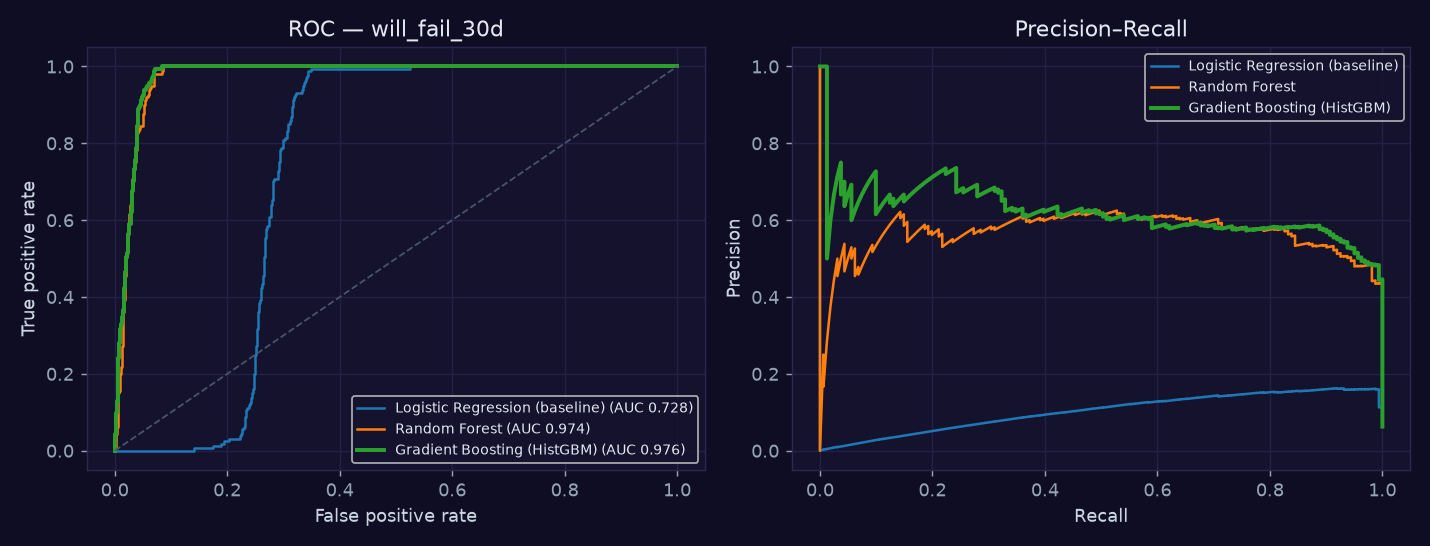
Will-fail-in-30-days - classification
| Model | ROC-AUC | PR-AUC | Recall | F1 |
|---|---|---|---|---|
| Gradient Boosting (HistGBM) ✓ | 0.976 | 0.623 | 0.590 | 0.588 |
| Random Forest | 0.974 | 0.567 | 0.876 | 0.665 |
| Logistic Regression (baseline) | 0.728 | 0.103 | 0.783 | 0.253 |
Remaining useful life - regression
| Model | MAE (days) | RMSE | R² |
|---|---|---|---|
| Gradient Boosting (HistGBM) ✓ | 5.73 | 14.73 | 0.923 |
| Neural Net (MLP) | 6.60 | 14.73 | 0.923 |
| Random Forest | 6.26 | 15.37 | 0.917 |
| Ridge (baseline) | 13.12 | 20.81 | 0.847 |
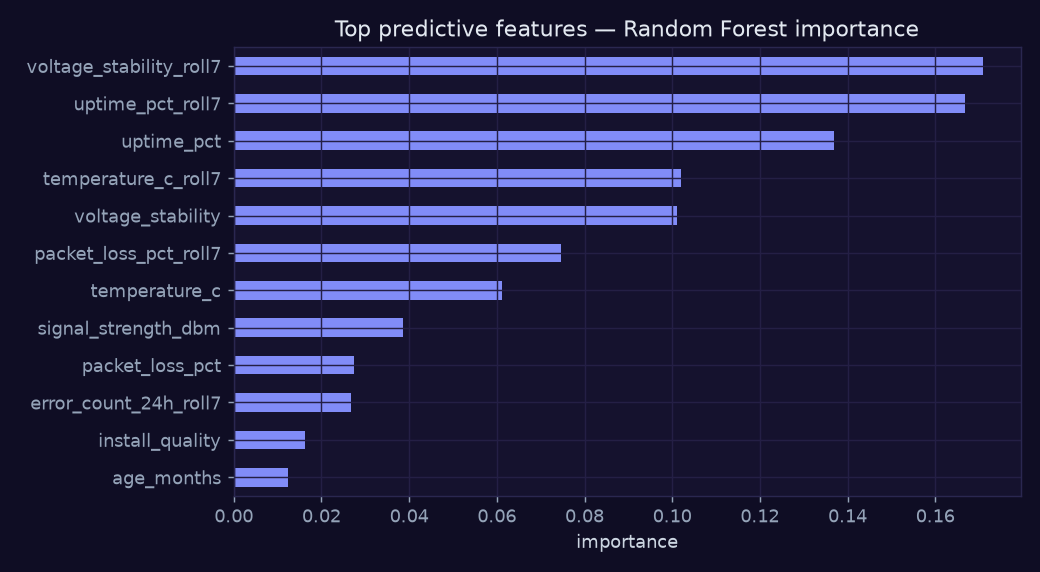
Best model predicts failure ~0.98 ROC-AUC and pinpoints the failure date to ±5.7 days. Top features are 7-day trends in voltage, uptime & temperature - trajectories, not snapshots.
POC #2 Results: Traffic Forecast & Dynamic Speed
Next-hour volume forecast → congestion windows → weather-aware variable speed limits
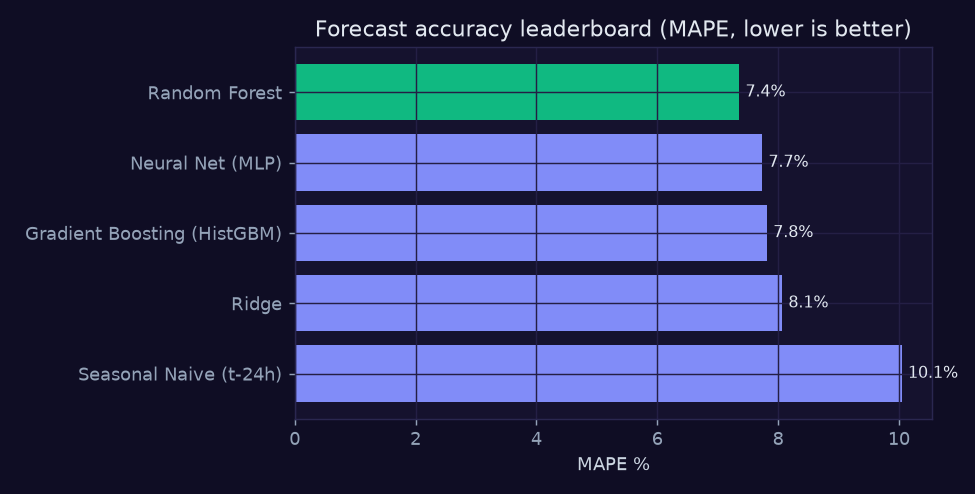
Short-term forecast - leaderboard
| Model | MAPE | RMSE | R² |
|---|---|---|---|
| Random Forest ✓ | 7.36% | 275 | 0.939 |
| Neural Net (MLP) | 7.74% | 283 | 0.935 |
| Gradient Boosting (HistGBM) | 7.82% | 289 | 0.933 |
| Ridge | 8.07% | 298 | 0.929 |
| Seasonal-naive (baseline) | 10.05% | 367 | 0.892 |
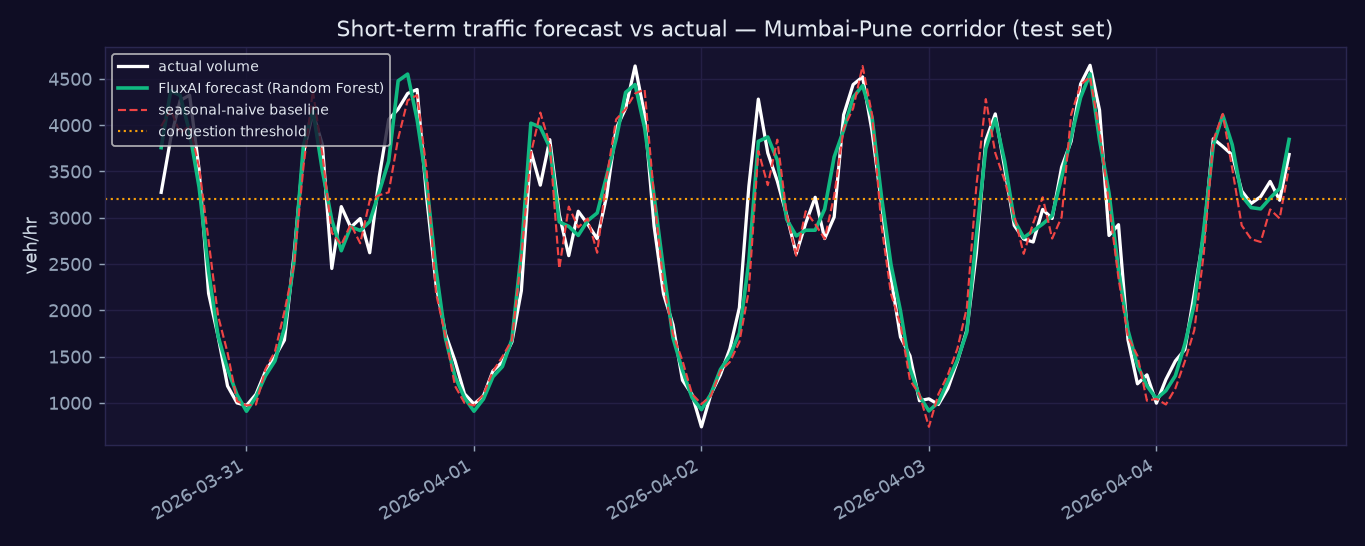
7.4% MAPE sits squarely in the 5-10% band reported for state-of-the-art short-term highway forecasting - and beats the naive baseline by 27%. Congestion-window detection F1 = 0.91.
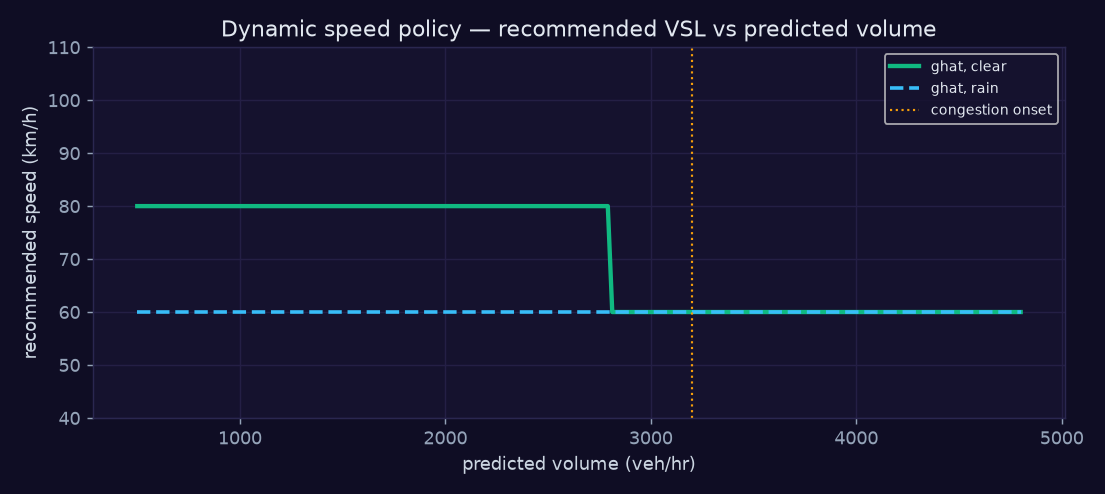
The forecast feeds a deterministic VSL policy (density × weather × ghat). Replacing one static limit with a dynamic one cuts speed-limit variance - the mechanism behind the ~20-35% crash reduction reported by mature VSL corridors.
Code, Repository & Reproducibility
A clean, hand-over-ready repo - your software team can read, run and extend it
Repository structure
Model leaderboard & time-split src/asset_health/train.py
From POC to pilot: swap these CSVs for live NMS/ATMS/ANPR/weather feeds - the same features, split & leaderboard apply. Add XGBoost/Prophet/LSTM, a model registry, monitoring & on-prem serving.
From Synthetic to Live: Data, Weather & Scope
What's built today, how it connects to live feeds, and what comes next
Weather: consumed, not forecast
We don't predict weather - that's a solved commodity. FluxAI consumes a weather feed and fuses it with the traffic forecast into the speed decision and VMS message. Three time-horizons feed the model:
- Now / ground truth
Roadside RWIS sensors + API 'current' + IMD radar nowcast → the immediate "RAIN AHEAD" VMS advisory
- Short-term forecast (1-6 h)
Weather API - IMD / OpenWeatherMap / Tomorrow.io / Visual Crossing → proactive speed planning before rain hits
- Historical archive
Used to train the models - what this POC ran on. Going live swaps in the API + sensors with no model change.
POC scope: built vs roadmap
- Predictive Asset Health
Tabular ML on NMS telemetry - failure classification + remaining-useful-life
- Traffic Forecast + Dynamic Speed
Tabular time-series forecast + weather-aware variable-speed-limit policy
- Road-Condition Computer Vision
Dashcam defect detection - cracks, potholes, faded markings, missing signs, encroachment - via CNN/YOLO, aligned to NHAI Rajmarg Saathi / Data Lake. Not in this POC.
- Enforcement & ANPR analytics
Repeat-offender / vulnerable-vehicle detection from ANPR history
Why Now
NHAI tenders & global ITS leaders are moving from reactive ops to predictive AI
Reactive Today vs FluxAI
| Capability | Today | With FluxAI |
|---|---|---|
| Maintenance | Fix after failure | Predict weeks ahead |
| Field dispatch | Reactive truck-rolls | Right engineer + part |
| Speed limits | Static signs | Dynamic, weather-aware |
| Network faults | Investigated ad-hoc | Chronic zones flagged |
| Cross-asset view | Siloed NMS alarms | One live truth |
| "Why did it fail?" | Hours in logs | Instant, plain English |
The competitive signal
Acusensus - co-founded by Ador Powertron's own Executive Chairman and deployed in India as Ador Harmony - went fully AI-first and is now ASX-listed, scaling across the US, UK & Australia. The AI DNA is already in the Ador family. NHAI's newest programs - the Data Lake, Rajmarg Saathi AI dashcams and Delhi-NCR ATMS - increasingly demand predictive analytics & condition monitoring, not just hardware.
Ador's years of NMS, ANPR & enforcement data is a moat - once it's turned into models. FluxAI extends your family's AI-first philosophy from detection to prediction, on top of your existing stack.
Be the bid that wins
NHAI is rolling out ATMS across 1,205 km in Delhi-NCR and weekly AI dashcam surveys into its Data Lake. With overspeeding behind 71% of India's road deaths (MoRTH 2022), a working predictive & dynamic-speed demo on the Mumbai-Pune Expressway turns "we can build it" into "here it is running" in your next tender.
What We're Proposing
Prove it on one corridor & two use cases - before scaling across the network
One corridor - the Mumbai-Pune Expressway. Two POCs: predictive asset health (NMS) + dynamic speed & road-condition. We tap your existing NMS/ATMS data, on-prem.
FluxAI predictions run live against your NMS/ATMS reality. Your software team judges accuracy, lead-time and the dynamic-speed logic with your own data.
Convinced? Roll out to other corridors & NHAI projects, and add enforcement analytics & dashcam anomaly - at your pace, with your team.
Recommended Pilot
Best Starting PointAsset Health + Dynamic Speed on 1 corridor
- Predictive failure & chronic-junction model on NMS assets
- Congestion + weather-aware dynamic-speed recommendations
- Plain-language AI assistant for your ops & software team
What we need from you
- 1-2 years of NMS / asset-fault & maintenance history (export is fine)
- Traffic-count / ANPR & weather data for one expressway stretch
- One point of contact from your software team to validate outputs
Next Steps
Let's move forward together
From reactive ops to a predictive highway brain
Working Session with Your Team
Bring in your software team - align on data access & lock pilot scope on one corridor
Pilot Kickoff & Success
Live in 6-8 weeks - predictive asset health & dynamic speed, proven on your data
Scale & Win Bids
Roll out across corridors & new use cases - and take a working demo into NHAI tenders